When Second Life Meets the Stage
My husband and I both come from theater backgrounds in “real life.” We actually met doing theater (okay, technically LARPing, but details, right?) and it’s been a thread woven through our marriage ever since. Interestingly, though, Second Life and real-world theater haven’t crossed paths very often for me. Other than the occasional joke from my husband about how building real-life sets isn’t quite like building in Second Life, they’ve mostly lived in separate creative worlds.
Second Life has always been my storytelling medium. It’s been my place to build environments, experiment with filming techniques, and create stories — but it’s rare that I get to bring those skills into real-world productions with people I actually know. That changed recently in a way that made my inner theater nerd ridiculously happy.
While working on stage design for a musical we’re involved in, Gonje mentioned recording video in Second Life to use with a stage syke.
For anyone who isn’t deep in theater terminology, a syke is a thin sheet of fabric hung between poles on stage. It can be raised or lowered and is designed to catch light and projections, adding depth and visual interest to a stage production. Silk versions, called scrims, can even appear invisible with the right lighting. They’re like magical tools that let you do effects you simply can’t achieve otherwise and they are super fun to play with on stage. Now I’m not a theater professional, so I’m honestly not even sure if I’m spelling this right…but here is a link for more information so you can really understand what I’m talking about. LINK HERE and also HERE
Naturally, I went down a research rabbit hole to see what kinds of visuals people typically project onto sykes. What surprised me was how often they’re simply static images meant to suggest a location. When video was used, it rarely felt dynamic o interesting enough to help draw the audience into the scene itself.
That realization made me really excited. Building sets is my favorite thing to do in Second Life. I’m not the kind of creator who can sculpt something from scratch out of a prim block, but I am very good at taking existing pieces and tweaking, retexturing, and arranging them into spaces that feel alive and interesting. Using that skill to create projections for a syke felt like a fascinating challenge, and honestly, one that Second Life seemed uniquely suited for.
Gonje’s idea was to create “stagnant sets” in Second Life and film them for the duration of a scene or song. Essentially, we’d use Second Life as a creative engine to produce animated 4K video backgrounds that could be projected onto the syke at the back of the stage. We’ll play the video during scenes, swap them between numbers, and potentially layer effects depending on cues in the show.
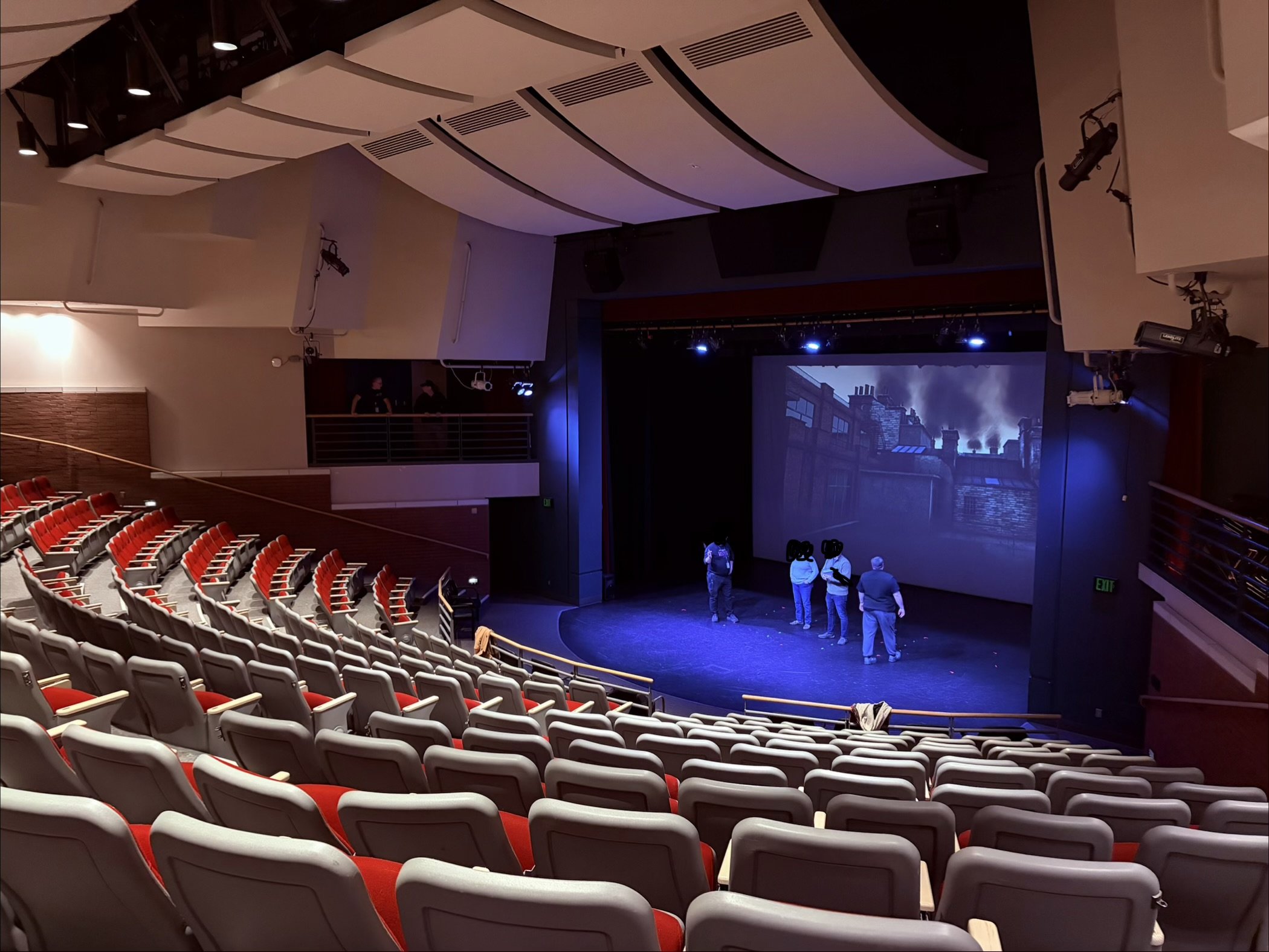
I created a few test clips but told Gonje I really wanted to see them projected before committing fully. I needed to know if the concept would actually work; how clear the image would be, how it would blend with the physical set, and whether I’d need to adjust the footage. After a bit of scheduling magic, we managed to get some time in the theater to test projections… and I was amazed. It looked great.
One of the test clips included a subtle fade-to-black along the bottom edge, which helped the projection blend naturally into the dark stage floor. I also tested small moving elements, like birds, to see if they’d still read from the back of the theater, and added smoke effects to understand how motion would feel on the screen.
I’m so excited about how well it translated. Second Life’s slightly stylized quality actually complements stage productions beautifully. Many shows traditionally rely on painted backdrops anyway, so projecting a moving environment feels like a natural evolution of that idea, just with more depth and flexibility.
Because the projection is essentially video and amazing Second Life creations, it opens up so many possibilities: layered effects, transitions, subtle movement, and dynamic atmosphere changes that would be impossible with traditional scenery alone. I can’t wait to build out the full set of “slides” (or however they ultimately evolve) and watch the magic happen live on stage. It’s incredibly cool to see Second Life shine in a completely new way after all these years.
Below is a quick snapshot from our projection test — a very cool day indeed.
EDIT 2/26/26: Wanted to add this little bit of info on the actual ‘spelling’ I mentioned above. It’s spelled ‘cyc’ like cyclorama. https://en.wikipedia.org/wiki/Cyclorama_(theater) Thank you Cranston!!!!! :)