Can you build a financially sustainable creative business inside Second Life? I'm determined to find out and I've decided to document the process. Welcome to the first installment of The Bay City Studios Accountability Project.
If you’ve been following along in my little Second Life journey over the years, you know that Bay City Studios isn't a new business. I've been creating things in Second Life for quite some time, from role-playing regions and machinima to virtual experiences and game development. But I've reached a point where I want to take a more serious look at the business side of everything I'm doing.
How much does it cost? Where does the money go? Which projects have potential? What am I doing wrong? And perhaps most importantly, can I make enough money to keep doing this without continuously funding everything out of my own pocket?
I'm going to share the expenses, the revenue, the accomplishments, the mistakes, and the occasional questionable decision with you. I'm also going to talk about Linden Lab and their business practices because operating a business inside Second Life means operating a business inside somebody else's business…… and that creates some interesting challenges.
Bay City Studios: “A Business Inside a Business”
If you didn’t know, Second Life is considered a SaaS company; a ‘subscription as a service’ because it operates on a recurring-revenue model. Residents pay for memberships, land, and virtual currency, and the company benefits from an enormous amount of content and activity created by its residents. It's a brilliant business model, but one of the things I've been thinking about recently is how much Second Life depends on the passion of its community.
When I was in my early twenties, I was involved in a very active live-action role-playing game with hundreds of players. We’d rent out a state park for the weekend and the team would transform this place into a fantastical world that people could immerse themselves in.
If you've ever spent time around LARPers, you know we're a pretty hardcore bunch. We'll spend ridiculous amounts of money on costumes, props, and settings. We'll learn obscure skills like weapon fighting and sewing and we’ll volunteer our time to make the game better. I once made a waterproof cloak with hidden pockets for daggers, realized I'd made it wrong, seam-ripped the entire thing, and sewed it again. And it wasn't even for me; it was for the game.
That kind of dedication is one of the things that makes communities like LARPs, churches, community theaters, and yes, even Second Life so wonderful. People genuinely care about what they're creating and are passionate about making the project better.
But volunteers can also create problems, especially when organizations rely heavily on volunteers and reward them with special access, recognition, or privileges. Transparency becomes incredibly important for volunteer labor to really work and without it, people begin competing for access. Information becomes a form of currency and when rumors spread, people start wondering whether everyone is being treated fairly.
For whatever reason, Second Life continuously tries to repeat this lesson they have learned over and over again. I've watched versions of this happen in different communities for many years, and even after continuous attempts at pointing out the obvious flaws in the system, it’s something that the company continues to lean on to get things done.
So why does that matter to Bay City Studios? Because I'm investing real money into a business that depends on this platform.
If the business environment isn't healthy, that affects my ability to build something sustainable and part of this accountability project is going to involve examining the decisions Linden Lab makes and how those decisions affect businesses like mine. October was a busy month and gave me a couple of things to think about.
Red Flag #1: The Mole Identity Changes
One of the things that concerned me this month was the removal of the recognizable Mole last name from certain Linden Department of Public Works identities. From a product-design perspective, I don't understand this decision.
The Mole identity has historically made it easy for residents to recognize people associated with the program. Replacing that recognizable identity with something that requires residents to inspect group memberships (memberships that are hidden from the Public) seems like an unnecessary complication.
I've heard the explanations involving restructuring directly; I asked Izzy Linden about it at the last Land Meeting held in Second Life for the 2026 year. My take away on this meeting? My own personal years working in a ‘SaaS’, I read ‘corporate speak’ pretty well. I also admit ‘spicey’ responses from employees over very simple questions make me even more suspicious. Whether or not this was Izzy being spicey or Izzy being caught in a weird situation, the entire exchange made me even less convinced that the decisions were about ‘corporate restructuring’. Communication is key here; it’s something Linden Lab has promised it’s residents after years of ‘weirdness’ and ‘favorites’. This team should have been prepped for conversation by their PR department because the normal ‘Linden Lab way’ of pretend like they ‘didn’t know what the issue was’ was simply annoying. After 9 pages of forum pages, a Feedback request on Canny, and a fair amount of social media buzz…to pretend like they ‘didn’t know’ was a little insulting. Also how quickly the team tried to ‘change the subject’ when I asked was obnoxious; I was obviously typing and I didn’t even have 10 seconds to write a response before they’d moved on to something else. I actually had to jump on voice to even get a real answer to what was going on. Let’s be real: they aren’t even being honest about the fact that residents can’t see the ‘Member List’ of the LDPW: group they want us to check.
My concern is about transparency and trust, and since it’s obvious the Lab isn’t going to be honest with us and any questions are going to be met with the usual animosity on the forums and public meetings, I’m left to come up with my own theories what what I’ve seen or the outside commentary raising additional concerns about contractors' actual jobs being replaced with ‘free labor’ from volunteers. This seems much more in line with what the truth likely is.
Second Life has a long history of relying on passionate residents to help build and maintain its communities, but those people aren’t employees. Volunteers can’t be held accountable for their bad work or their actions because it’s ‘free’. I think it's important that residents understand who is representing official programs and how those relationships work. Making that less obvious seems like a step in the wrong direction, especially for a company that regularly complains about how difficult it is to retain new residents.
Red Flag #2: Mainland Tier
My second red flag is a little more expensive; actually, it's a LOT more expensive. I currently pay $457 USD every month in mainland tier and that's just the land. It doesn't include my websites, servers, software subscriptions, development assets, or anything else associated with running Bay City Studios.
I originally acquired much of this land with particular expectations about its usefulness and capacity, but as we all know, changes involving land impact and prim allowances (particularly in comparison with Linden Homes) have made me question whether the original investment still makes sense. I've also watched other mainland owners struggle to attract renters on some of the most beautiful mainland builds I’ve ever seen. Remember Summit Pines? Skylar had an absolutely beautiful mainland build and ended up downsizing because the rental demand simply wasn't there and that's concerning.
I currently have roughly 2.5 regions' worth of land in Heterocera.
That's an enormous amount of creative space, but at nearly $500 per month, it's also an enormous financial responsibility. If I'm going to keep it, I need to find ways to make it worthwhile and make it ‘work to pay for itself’. Fortunately, there are some green flags.
Green Flag #1: Creative Freedom
Having all that land gives me an incredible amount of room to build.
I can spread Everlife's farming and activity systems across multiple locations instead of concentrating everything in one place. I can make my sight lines beautiful from that mainland mountain, which is pretty rare over all. I can build sets for NAMARA and I can develop spaces for The Guild and other filmmaking projects. I can also offer public experiences that give residents more reasons to explore mainland and wear ‘Everlife’ through it so players have tons of places to explore.
All of that flexibility has genuine value, but the honest question is whether the studio can eventually generate enough revenue to justify the expense.
Green Flag #2: My Premium Plus Store
I have a Premium Plus commercial storefront. This is a particularly useful benefit because it gives me an alternative if I ever decide to substantially reduce my mainland holdings. I could let go of most of the expensive land and still maintain a store. It would be heartbreaking and super sad, but that’s a wonderful safety net and I intend to keep it for as long as I possibly can.
What Bay City Studios Worked on in October
October was a ridiculously productive month. Although Bay City Studios has several projects underway, Everlife occupied a substantial amount of my development time because we officially opened the game on October 1. That being said, there were also developments involving NAMARA, The Guild, and the studio's broader business plans.
Everlife: A Second Life Game
It started with the Everlife opening. In case you are just catching up here, Everlife is Bay City Studios' life-simulation game for Second Life. Players can farm, cook, fish, explore, collect discoveries, complete Adventures, and collect doubloons as they travel around the grid. October 1 was our public opening, and much of the month involved improving the experience for new players. I worked on the New Player Helper, the Adventure Cabinet vendor, and tools for reassigning character traits. I also expanded Japanese and English support with the goal being to make Everlife easier to understand and more welcoming to people who are just getting started.
We had our first server outage; it’s not exactly something you hope to experience during your opening month, but it resulted in one of our most important accomplishments because I went on to develop Everlife Mission Control, a monitoring system designed to help me understand what's happening with our servers. I spent the month examining server traffic, and started looking seriously at the system's ability to scale. Everlife has been designed with the long-term goal of supporting up to approximately 1,000 concurrent players. We're nowhere near that number today, but I'd rather learn how to manage the infrastructure now than wait until a large number of people are depending on it. I also retired the Daily Compass reporting mechanism; I think all the chatter was actually part of what was causing some of the traffic issues I was having and it just kind of gunked up the Discord server with tons of stats every day.
For me, one of the most valuable lessons I learned from this process was learning that not every error means something is broken. The design is good; most times a service recovers normally and the important thing is having enough information to tell the difference.
I expanded Everlife's resources with rosemary, lavender, mint, basil, and potash. I also added four levels of soap. :) Because Everlife's consumable system was originally designed around food, I had to modify the scripts so players would use the soap instead of eating it. (Yum yum) Game development is glamorous, what can I say? LOL I also explored perfume as a future item that could improve Hygiene and Social stats.
I got to use the ‘Wayfinder’ tool I made to give players credit for recipes they have submitted. I haven’t gotten any regions yet, but I have gotten tons about 8 recipes linking ingame items to other items to make meals. This always takes a little time for me to put together because the actual in game meal with with’s mesh needs to be made before I can add it to the recipe list, but when it’s all done it allows players to receive permanent discovery credit for other players to see when they discover the recipe themselves. I’ve got THREE active Adventures:
Keepers of the Light takes players on an educational journey through 16 lighthouses, with Japanese translation support.
Welcome to Bay City! is a 36-step guided exploration of Bay City, also with Japanese translation support.
I’m also almost done with ‘The Recipe Route’; a culinary Adventure that introduces players to cooking through 12 locations around Second Life and gives them tons of recipes and items to try on their own.
I also improved the Traveler's Cabinet, Quest Items, rewards, and Adventure administration tools. One of my favorite things about Everlife is that it encourages people to explore places they might otherwise never visit. Second Life has an epic amount of interesting mainland content and I want to give people reasons to discover it.
One of October's biggest design decisions for Everlife involved the Friendly system, and I want to talk about it here before I start reworking it next month. Originally, Friendly depended on beacons installed at registered locations, but I started questioning whether that was really the best approach. The more I considered it, the more I realized that requiring landowners to install objects was limiting the system and what the original intention of ‘Friendly’ was supposed to do: to find new people to meet. The new concept is a grid-wide social discovery network.
Players who enter the Friendly mood will be able to participate in an Everlife system that helps them discover other participating players anywhere in Second Life. We're planning a wearable Social Compass with three functions: Find Friends, Happening Now, and Friendly Ping.
I’m pretty settled on the redesign and I hope it will be a lot more helpful in connecting people that want to be social. Sometimes the best development decision is admitting that an earlier idea needs to change.
A Future Everlife Competition?
I piddled around for a day and started developing the concept of an Amazing Race-style competition inside Second Life. The preliminary plan involves six teams of two, approximately six episodes, and Second Life vloggers documenting their experiences. I’m still working on the rules of how it would all work and it's still an early concept, but I think it has potential.
NAMARA and The Guild
I'm also continuing to develop NAMARA and the filmmaking work associated with The Guild. This is one of the advantages of owning a substantial amount of mainland; having space available for production sets and places to film things.
I'm also starting to think more seriously about the money already invested in the comic version of NAMARA. I have a lot of pages and I believe the existing material could potentially be organized into three separate issues. I think my next experiment may be a small physical print run…something where I’d spend approximately $100 on printing supplies to see whether I can produce something that looks professional enough to offer to readers and sell.
I also know that next month I want to get back on a tighter film schedule, so I'm also planning future NAMARA production expenses, including set building and voice actors.
These projects aren't all at the same stage, and they won't necessarily generate revenue immediately, but if I want to ‘harvest’ any of the ‘fruits of my labors’, then I need to get the seeds in the ground now. They are all part of the larger creative business I'm trying to build.
Finding Other Second Life Creators
Another thing I worked on this month was finding people who might be able to help with future projects. I initially tried joining creator groups, but that wasn't particularly productive. Some groups didn't seem to consider games a form of creation, and others weren't especially active.
I had much better luck reaching out to creators directly. I posted advertisements for mesh creators on the Second Life forums and Primfeed because I wanted to reach people already familiar with Second Life. That introduced me to some remarkably talented people; it also reminded me how much work happens behind the scenes at established Second Life brands. There are incredibly skilled creators available for contract work, but the challenge I’m going to have is figuring out what to hire them for and how to make those expenses worthwhile.
I was also invited to participate in Playable in World, an event that seems particularly relevant to Everlife. I'd originally planned to avoid traditional shopping-event marketing, but an event focused on playable experiences in Second Life might be a good opportunity to reach the audience Everlife actually needs. I'm going to give it a try; now I just have to build a booth that doesn't use a billion prims! :)
Financial Report: October 2026
Let's talk money. One of the main reasons I'm doing this accountability project is because I want to document the real cost of operating Bay City Studios……not just what we earn, but what we spend, too. So…drumroll please…….
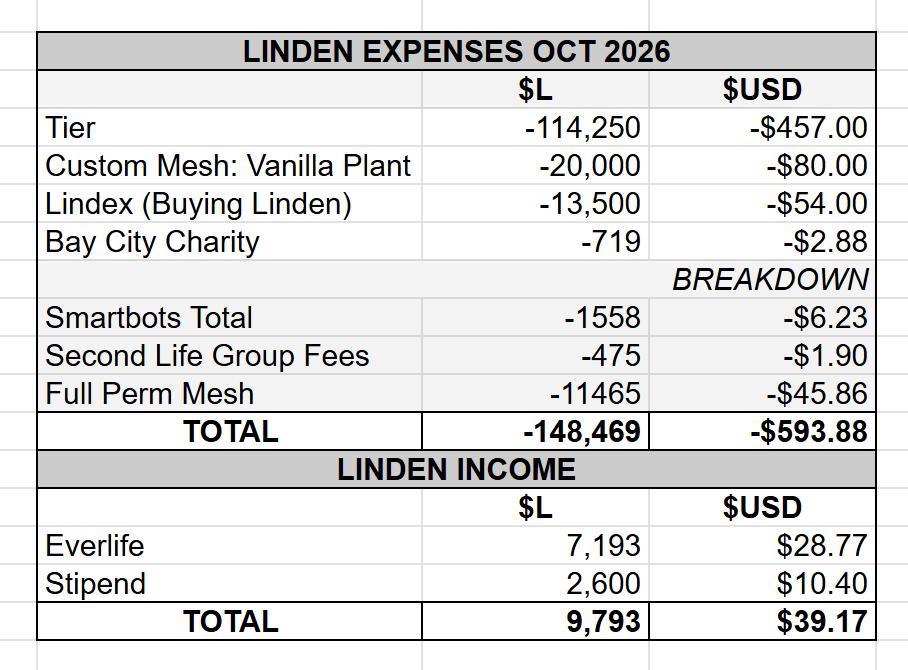
Ouch. Obviously, that's not sustainable indefinitely.
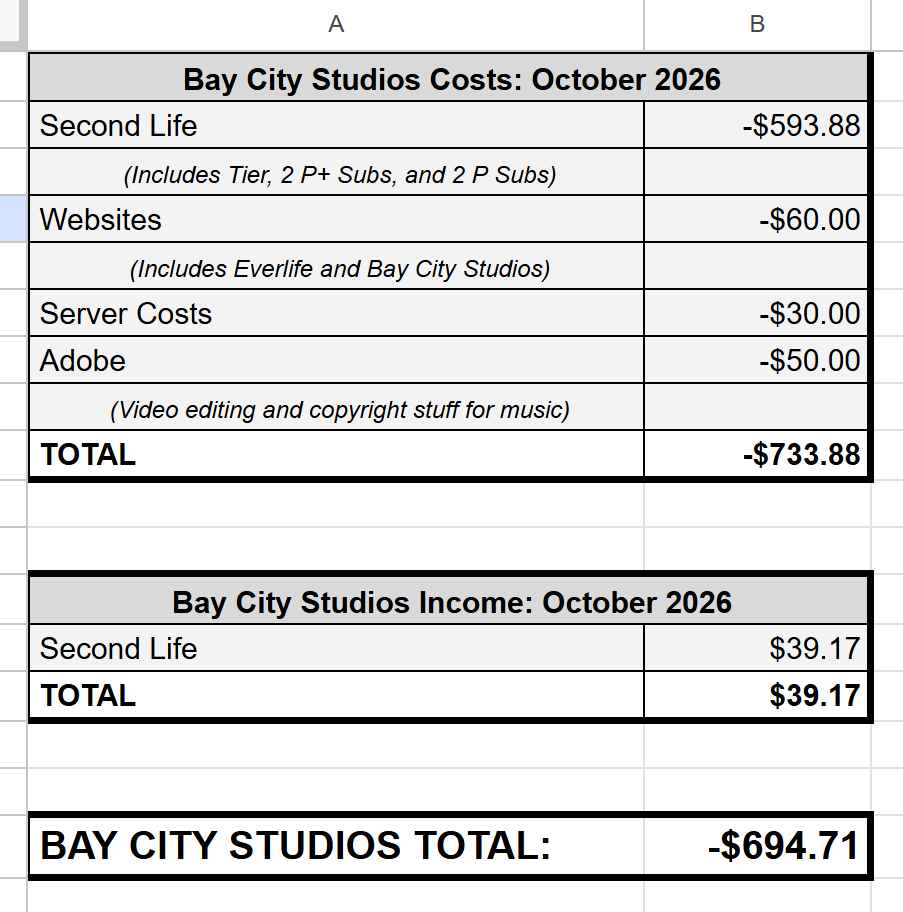
But it's also important to understand that Bay City Studios already has established expenses, and October included development purchases and the opening of a new game. Everlife generated $28.77 in recorded revenue during its first month.That isn't a lot, but it also wasn't supported by a substantial marketing campaign aimed at the specific audience I'm trying to reach. I'm interested to see whether that changes.
November: The Plan
I've started preparing financial estimates for the next two months. These are projections for Novemeber, not actual results.
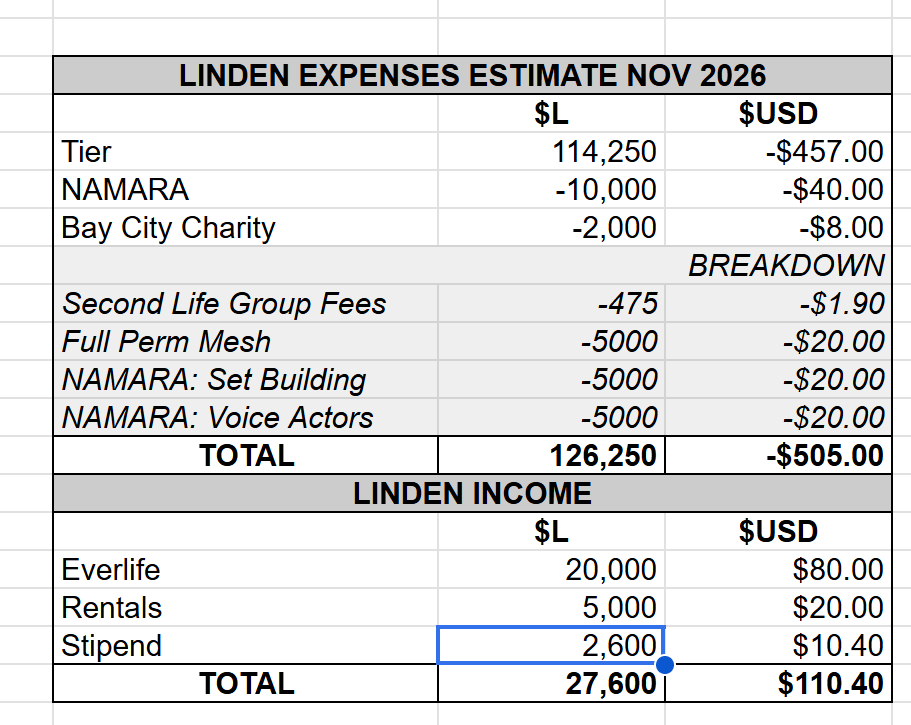
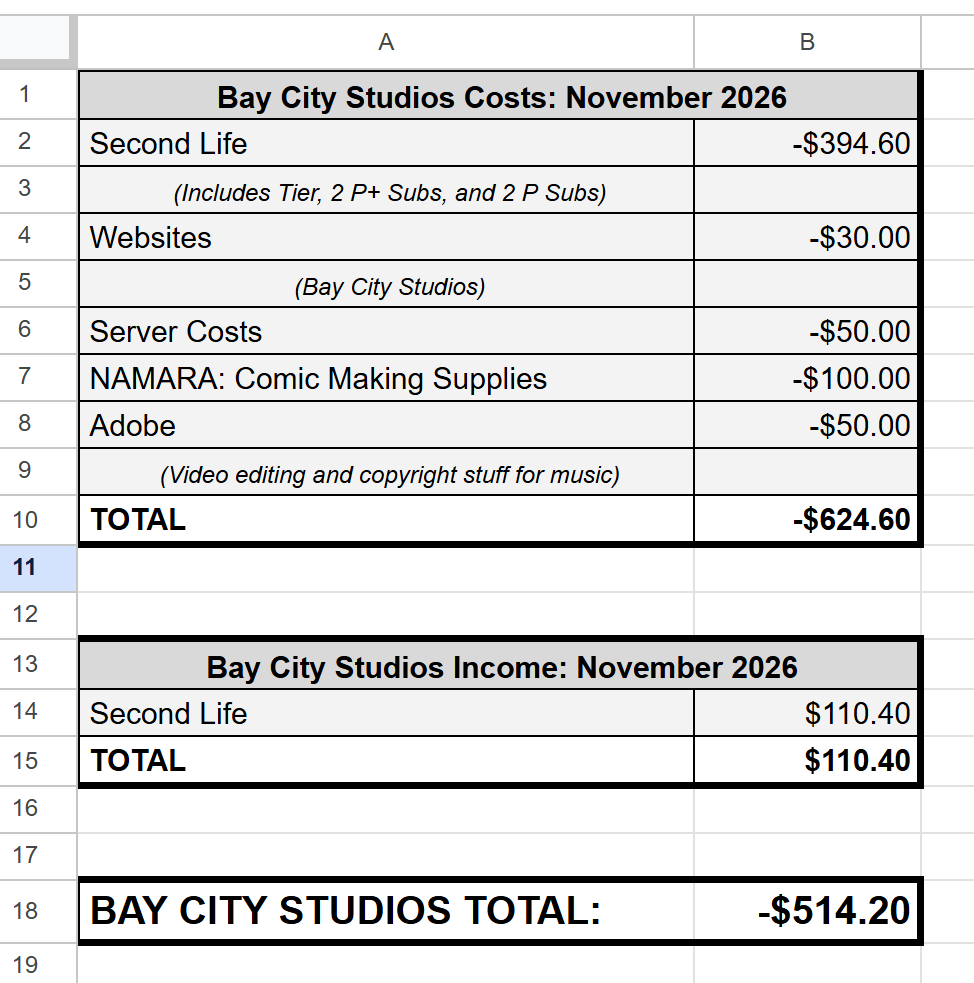
I'm projecting increased Everlife revenue, some rental income, and continued stipend payments. I'm also budgeting for NAMARA set building and voice actors. Also, these figures only represent the Second Life portion of the budget; they don't include the other studio expenses. I’m not looking to ‘make back everything I’ve lost’; the goal is to improve the financial picture without eliminating the creative work that makes the studio worth operating.
Changes I'm Considering
I've identified several things I want to work on.
Consolidating websites: Rather than maintaining unnecessary separation between project websites, I'm considering bringing Everlife under the main Bay City Studios website.
Server budgeting: October's server costs were approximately $30. I'm budgeting $50 per month going forward to allow for possible increases.
Discontinuing Smartbots: I don't think the subscription is necessary right now. I have a bot available if I need one later.
Developing Summit Pines: I'm considering turning part of the property into a small marketplace with rentable storefronts, ideally attracting creators who make complementary products.
Experimenting with NAMARA comics: I'm considering a roughly $100 investment in printing supplies to test whether I can produce a small, professional-looking physical comic run.
Make a Concise Build Across the ‘Summit Pines’ Estates: I’ve got a lot going on over there, and I need almost all of it to double as sets for NAMARA and be explorable for Everlife. This needs to be a focus this month.
These are ideas I'm evaluating, not guaranteed solutions. I know that going into this that some may work and some may turn out to be terrible ideas. And that's exactly why I'm documenting them! :)
So, Was October a Success?
Financially? Absolutely not. Bay City Studios finished October with a $694.71 operating shortfall.
But we also accomplished quite a bit! We launched Everlife, expanded its gameplay, developed Adventures, improved its technical infrastructure, and started examining what it would take to operate at a much larger scale. We made important design decisions. We explored new opportunities for NAMARA and The Guild. We connected with other creators. Perhaps most importantly, I started looking at Bay City Studios as a business that needs to justify its expenses rather than simply a collection of creative projects I enjoy.
I love Second Life and I love the creative freedom it provides, but I also recognize that passion doesn't automatically create a sustainable business. This is where we're starting; we'll see what happens in November!
Thanks for following along with the Bay City Studios Accountability Project, and if you're trying to build something of your own inside Second Life, I hope sharing this process helps you make a few better decisions along the way.